By day, your pond looks fine. Then the sun sinks, and it becomes a dark spot at the far end of the yard. That all changes with a floating pond fountain that has LED lights. The water in motion prevents the surface from becoming still, and at dark, the grey glow drags the whole pond toward a never-ending end. It no longer is something you forget about by the time it’s 8 p.m.
We put a small amount of thought into selecting the correct floating pond fountain with LED lights. Choose a unit that is too small, and the spray becomes more of a weak trickle. If you choose one that is too powerful, then the water splashes out over the sides, and energy is wasted for nothing. Here is how to nail it the first time around.
Why the Lights Are More Important Than You Think
The lights aren’t just for fancy, even though that is the part you fall for first. Lighting a pond means it will be a safer pond, with nearby people observing where the water begins after dark. No more guests drifting toward the blind side. And a fountain that glows is the kind of thing local residents talk about, too something some homeowners care more about than they might admit.
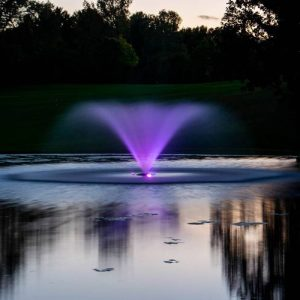
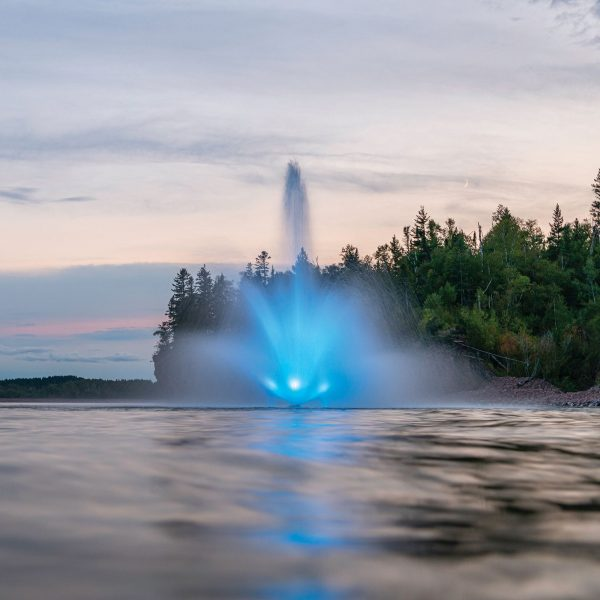
Under the majority of floats are color-changing or warm white LEDs. The light emanates from underneath, passing through the spray and creating the illusion that the water itself is colored. Warm white is usually soft and natural, whereas color-change modes suit a birthday or a holiday. Several units also have a sensor or timer in addition to it, so they turn on automatically at dusk without your intervention.
Getting the Size Right (GPH and Head Height)
There are two numbers that determine the health of your fountain. The first is gallons per hour (GPH), which is the amount of water pumped per hour. The second is called head height, which is the height to which the pump can push water before giving way under the flow.
A rough rule helps. Move a minimum of 50% of your pond volume each hour if you can. Therefore, a 1,000-gallon pond would desire to roughly pair with a pump of around 500 GPH or above, and an even wider spray calls for even more.
Head height is where people tend to go wrong. Most of the time, a pump that lists a large GPH number does so without lift in mind. To get a prolonged spray, push the water up and out; at the same time, let the bottom flow. Match the pump to the height of spray you really desire.
What to Check Before You Buy
It is a return later, in a few minutes, for verification. Before you buy, look at:
- Pond volume and surface area, so GPH is appropriate for the water.
- The pattern of spray available, considering some units change nozzles and others do not.
- Cord length from the float to your closest outdoor outlet.
- If the LEDs are replaceable or built into the unit.
- The pump warranty is for the part that does all the work.
Setting It Up
Most fear setup is difficult, and it is, in fact, easier than most people fear. A couple of steps could prevent you from some heartache down the road.
Source: https://www.fountaintechpumps.com/wp-content/uploads/2025/05/RGBWLEDblue-600×600.jpg
Float it close to the center for an even spray, away from waterfalls or returns that push it around.
From there, you can anchor it to the lines and weights given, so wind doesn’t park it into the liner.
The cord must be routed to an outdoor outlet protected by a GFCI. This part is not optional. The National Electrical Code requires GFCI protection on the electrical connections that supply power to outdoor water features.
Lay the cord underneath some stone or mulch so no one trips, and it is not mowed.
Simply plug it in, put the spray on for a couple of minutes in view, and after that, shift the nozzle or stream position until it resembles what you envisioned.
Care Through the Seasons
Not much can a fountain want from you? Clear the intake screen if you pull the pump every couple of weeks. Twigs, string algae, and sludge jam it up, and an underfed pump works overtime to fry itself early. While you are in there, rinse the LED housing itself so the light remains bright.
Remove the fountain once the water is frozen. Most floating units aren’t constructed to reside in the ice. Keep the pump in a location that is still somewhat damp, because seals dry out and can crack. It suffices to have a bucket of water in the garage. Odd, huh? Do it, and it does the job.
Correct sizing, use a safe outlet, and rinse off the pump every now and then. Do this, and you’ll have a pond that grows, breathes, and glows in the backyard long after the sun has set. It is all low-hanging fruit, and even being on call every night pays off literally.